
Magnetic Level Gauges VS Glass Level Gauges: Which Is Better For Your Application?

In high-pressure process plants across Europe, choosing how to monitor liquid levels inside a vessel is one of the most critical safety and operational decisions an engineering team can make. It is not just about checking a budget checkbox; it is about process containment, maintenance cycles, and worker safety.
For decades, standard Glass Level Gauges (both reflex and transparent variants) have been the traditional go-to solution for direct visual verification. However, as modern chemical, petrochemical, and power generation facilities face stricter environmental regulations and higher operating pressures, Magnetic Level Gauges have rapidly become the benchmark for high-risk applications.
If you are an instrumentation engineer, procurement specialist, or EPC contractor working on a European industrial project, deciding between these two technologies requires balancing initial capital expenditure (CAPEX) against long-term operational safety and maintenance costs. Let's break down how these two systems compare under real-world plant conditions.
Understanding the Core Technologies
Before comparing performance, it helps to look at the fundamental design differences between these mechanical level instruments.
What is a Glass Level Gauge?
A glass gauge relies on a thick, high-strength borosilicate glass window bolted to a metallic chamber. This chamber connects directly to the process vessel via valves, allowing the liquid to find its true level inside the gauge column.
- Reflex Glass Gauges: These use special prisms cut into the glass face. Light striking the glass in the vapor space is reflected back, showing a bright silvery white color. Light hitting the liquid zone is absorbed, showing a dark black color. This contrast makes clean liquids like water or clear hydrocarbons incredibly easy to read.
- Transparent Glass Gauges: These utilize two flat pieces of glass sandwiching the liquid chamber. By placing a light illuminator behind the gauge, operators can look right through the liquid. This is essential for seeing the actual interface line between two immiscible liquids (like oil and water) or observing the color of the process fluid.
What is a Magnetic Level Gauge?
A magnetic gauge is a completely sealless, leak-proof system. It consists of a bypass chamber constructed from non-magnetic piping (such as 316 Stainless Steel, Hastelloy, or Titanium) mounted to the side of the vessel. Inside this chamber is a engineered, hermetically sealed float with a built-in internal permanent magnet array.
As the liquid level rises and falls, the float moves with it. The magnetic field passes right through the solid steel pipe wall to flip a series of external, highly visible bi-color flags or rollers housed in a sealed indicator rail. The flags change color (typically white to red) to provide a clear, high-contrast visual representation of the liquid level without any fluid ever leaving the containment chamber.
Direct Comparison: Engineering & Operational Factors
To help procurement and engineering teams choose the right equipment, let us compare these two instruments across critical plant metrics.
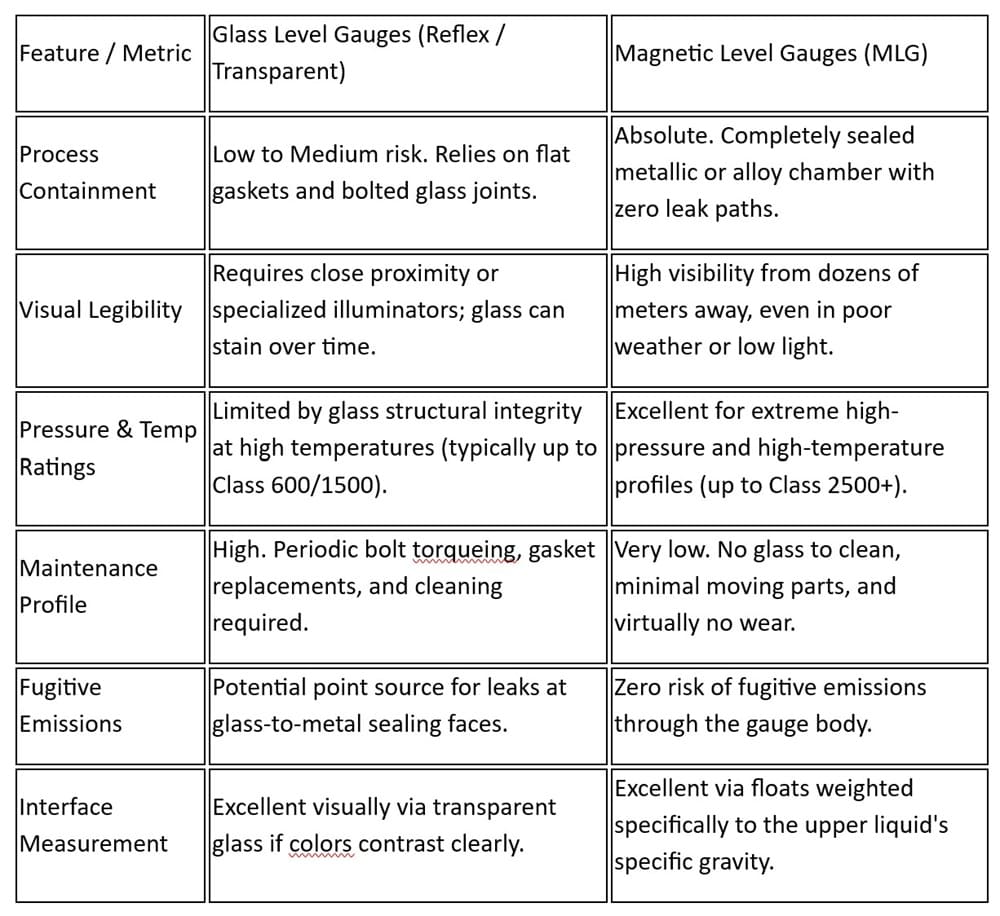
Critical Engineering Considerations for Process Applications
1. Total Process Safety and Leak Prevention
In hazardous chemical processing and offshore Oil & Gas installations, minimizing potential leak points is a top design priority. Glass gauges rely heavily on compressed flat gaskets. Over time, thermal cycling, pressure spikes, and chemical attack can degrade these seals, leading to pinhole leaks or fugitive emissions. In extreme scenarios, thermal shock can cause glass cracking.
Because a magnetic gauge features a fully welded metal chamber, it completely eliminates the risks associated with glass breakage and sealing face failures. For toxic, flammable, or lethal fluids (such as sour crude, anhydrous ammonia, or acids), an MLG is inherently the safer engineering choice.
2. High-Pressure, High-Temperature Cleanliness
As a premier Glass Gauge Manufacturer, we know that glass has structural limits. When operating steam boilers in power plants or high-temperature reactors in petrochemical complexes, glass becomes susceptible to "glass washing" - where hot, alkaline boiler water slowly dissolves the borosilicate material. Mica shields can mitigate this, but they eventually cloud up and require replacement.
Magnetic gauges handle extreme thermal dynamics with ease. Because the chamber is built to the same pipe specifications as the process vessel, it naturally satisfies strict European pressure piping and environmental safety guidelines.
3. Visibility and Operator Efficiency
If an operator has to walk up to a distillation column in the middle of a winter storm or during a night shift to read a level, small variations in a glass gauge can easily be misread. A magnetic gauge offers clear, high-contrast red and white indicators that are easily readable from 30 meters away.
Furthermore, if you want to send a 4–20mA, HART, or Profibus signal back to the central control room (DCS), a magnetic gauge makes it simple. You can strap an external magnetostrictive or guided wave radar transmitter to the outside of the chamber without adding any extra process penetrations.
Industrial Use Cases: Matching Technology to the Loop
When to Specify Glass Level Gauges
- Boiler Steam Drum Level (Low to Medium Pressure): Excellent for direct, code-compliant visual verification of water lines where ASME or local European regulations dictate a direct-view glass instrument.
- Refinery Interface Tracking: Transparent glass allows operators to visually inspect the cleanliness and color separation of an oil-water interface layer in a separator tank.
- Low-Budget Utility Lines: For simple water treatment tanks, lube oil systems, and chemical storage skids operating at moderate temperatures and ambient pressures.
When to Specify Magnetic Level Gauges
- High-Pressure Gas Condensate Tanks: Where high pressures (Class 900 and above) make glass gauges structurally risky or cost-prohibitive.
- Toxic and Corrosive Chemical Storage: Applications involving hydrofluoric acid, chlorine, or benzene where preventing any potential escape to the atmosphere is mandatory.
- Cryogenic Applications: Liquefied natural gas (LNG) loops where glass would immediately frost over. An MLG can be ordered with a specialized frost-insulation extension to keep the indicator rail clear and legible.
European Manufacturing Standards and Compliance
Engineering procurement within the European market demands strict adherence to safety, quality control, and regional manufacturing certifications. Whether you are installing equipment on a refinery skid in Germany or a chemical plant in the Netherlands, your instruments must comply with several core standards:
- Pressure Equipment Directive (PED 2014/68/EU): Any instrument operating under pressure must be designed, fabricated, and pressure-tested according to PED guidelines to guarantee structural integrity under load.
- ATEX Directive (2014/34/EU): For magnetic gauges fitted with electrical transmitters, switches, or continuous reed-chain sensors operating in explosive dust or gas environments, full ATEX certification is mandatory.
- ASME Section VIII & B31.3: Widely respected by global engineering firms executing major EPC projects across Europe, ensuring international piping standardization.
Partnering with a reliable Level Instruments Manufacturer & Supplier in Europe ensures that all your documentation- from material traceability certificates (EN 10204 3.1) to weld procedures (WPQR/WPS)-is fully compliant right out of the box, preventing costly commissioning delays.
Final Verdict: Which is Better?
There is no single "best" gauge; there is only the right instrument for your specific process parameters.
Glass Level Gauges remain an incredibly reliable, time-tested, and cost-effective choice for low-to-medium pressure applications where seeing the actual fluid color or interface with your own eyes is an operational advantage.
However, if your process loop involves high pressures, extreme temperatures, toxic media, or high maintenance costs due to frequent gasket replacements, migrating to a Magnetic Level Gauge is the superior engineering decision. The initial capital outlay is offset by reduced maintenance downtime, enhanced operator safety, and zero risk of catastrophic glass failure.
Frequently Asked Questions
Can magnetic level gauges handle fluids with suspended solids or magnetic particles?
If a process fluid contains high amounts of iron filings or magnetic particulate matter, these solids can accumulate around the float's internal magnet array over time, causing it to drag or bind. For these specific applications, a transparent glass gauge or an MLG fitted with an internal magnetic particle trap is recommended.
How often do glass level gauges need to be maintained compared to magnetic gauges?
Glass gauges require periodic checking of bolt torque values to prevent uneven loading and gasket leaks. Depending on the process fluid's corrosiveness and thermal cycles, gaskets may need replacement every 6 to 12 months. A magnetic gauge is virtually maintenance-free, requiring only an occasional flush of the chamber via a bottom drain valve if the process fluid is dirty.
Are magnetic level gauges code-approved for power plant steam boilers?
Yes. Modern ASME and European codes permit the use of magnetic level gauges on boiler systems, provided they are designed to the correct pressure ratings and are often paired with a secondary, direct-view glass instrument or electronic remote drum level indicator for redundancy.
What is the maximum height achievable for a magnetic level gauge?
Because magnetic gauges are constructed from standard metal piping sections, they can be fabricated to heights exceeding 6 meters. For exceptionally tall vessels, chambers are built in flanged sections with staggered internal floats to manage weight and buoyancy correctly.
Partner with Bliss Europe for Engineering Precision
At Bliss Europe, we design and manufacture high-performance process instrumentation tailored directly to your facility's operational demands. Based in the Netherlands, we serve EPCs, plant operators, and industrial buyers across Europe with fully certified, safe, and reliable solutions.
Whether your next project requires a custom-engineered Magnetic Level Gauge Manufacturer or a rugged Glass Gauge Manufacturer, our engineering team is ready to review your process data sheets and deliver code-compliant designs.
Take the Next Step
- Request a Technical Quote: Send your process parameters directly to our sales office.
- Contact Our Engineering Team: Discuss specialized material options (Hastelloy, Monel, Titanium) or unique installation dimensions.
- Download Product Datasheets: Access full dimensional drawings, pressure-temperature ratings, and compliance portfolios.
-